
The Whale – A Knowledge and Experience Centre
The Whale is a knowledge and experience centre focused on whales, the ocean, and the environments whales depend on. Through science, art, sound, storytelling and architecture, visitors gain insight into how whales live and their role in marine ecosystems.
The Whale opens to the public on 4 June 2027

The experience and concept
The exhibition concept was developed within The Whale over several years and explores not only whales themselves, but also our relationship with them, their place in human culture, and why they continue to fascinate us. The vision for the exhibition is to create a place where art and science are seamlessly interwoven to produce a playful, artistic, beautiful and unconventional experience.
The concept, curatorial direction and content framework were developed by The Whale’s multidisciplinary exhibition team, led by marine biologist, author and exhibition developer Hanne Strager and concept developer and 3D artist Joakim Engel, together with Camilla Ilmoni, Svein Spjelkavik, Frederik Wolff Teglhus, Anne Beate Hovind and Lars Holm.
Ralph Appelbaum Associates has led the exhibition design development in close collaboration with Tamschick Media+Space and a wide range of artists, scientists, engineers and specialist partners.
The building and architecture
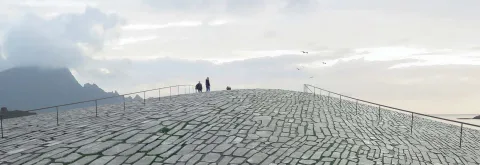
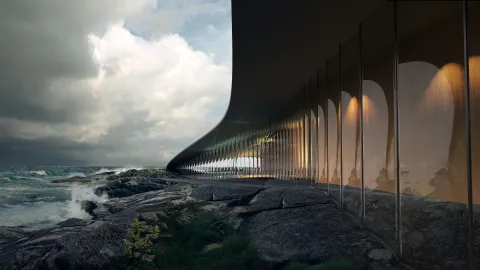
The landscape surrounding The Whale is essential to the shape of the building. The form of the roof is defined by three high points on the site, where the curved shell gently lifts from the ground, creating openings towards the surrounding landscape. Situated between Andenes and the open sea, the building acts as a transition between the town and the Arctic scenery – open towards the ocean and mountains while maintaining a close relationship with the shoreline.
The roof becomes a public viewpoint that visitors and locals are invited to explore. From here, you can overlook the archipelago, marvel at the midnight sun’s reflection in the ocean, or watch the Northern Lights dance across the sky. Norwegian slate and local vegetation such as salt meadow extend the character of the surrounding landscape onto the roof. Its aerodynamic shape responds to the exposed climate of Andøya, reducing adverse turbulence effects and minimising the accumulation of snow.


Experience Areas
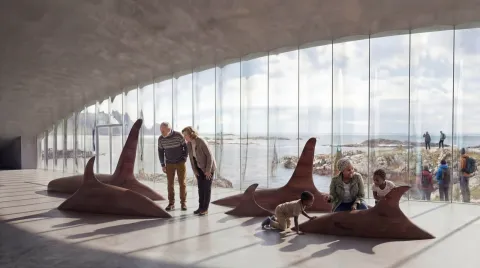
A Killer Whale Family
A pod of killer whales breaks the surface in perfect synchrony. These life-sized sculptures, with every curve and contour of five individuals known to swim in Norwegian waters, are carved in wood. To stand among the fins and lay hands on their smooth backs is to feel part of their family.
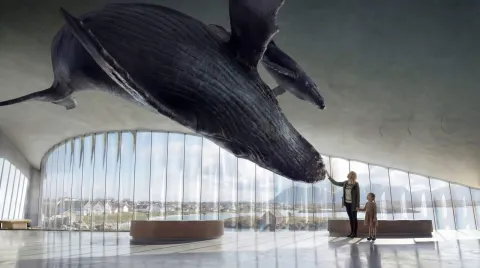
The First Encounter
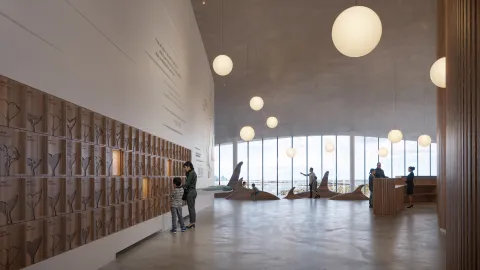
At the centre of the space, a full-scale whale sculpture introduces visitors to the physical presence, sounds, and behaviour of whales. Through form, scale, and sound, this encounter explores whales as social mammals and draws attention to similarities between whale behaviour and human interaction, such as communication, cooperation, and care.
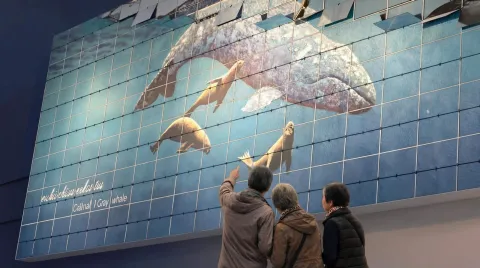
Species Gallery
Whales adapted to life in the sea 50 million years ago. They lost their hair and hind limbs, they developed a streamlined body shape and a tail, and they learned how to communicate underwater. All 90 modern-day species of whales fill this room in a mesmerizing and ever-evolving dynamic art installation that wows visitors with their diversity.
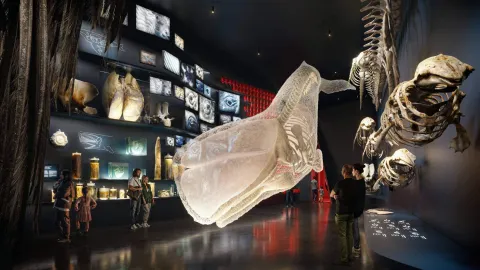
Under the Skin
In this mysterious vault lie shelf upon shelf of anatomical treasures. Body parts—strange masses and blobs—that bulge against glass containers appear intimate yet otherworldly. Hundreds of jars hold the blood of one whale. A curtain of baleen hangs from the ceiling like the hair of a giant. Weathered ribs span the room like gothic arches. Massive skulls stand like sculptures. Many of the bones are as recognizable in form as our own but those belonging to the whales are massive. In an intimate alcove at the end of the gallery, visitors will experience the slow rhythm of a diving whale’s heart.
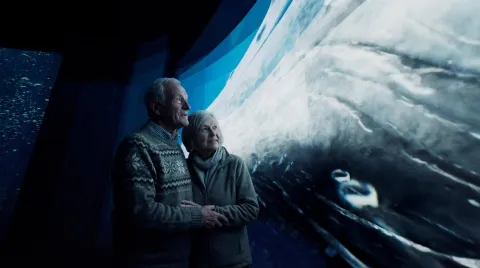
Below the Surface
This all-encompassing encounter plunges visitors into a deep sea realm where whales lunge at krill, dive for squid, herd herring, nurse, breathe their last breath, sink to the sea floor and fuel the cycle of life in the sea. It’s a breathtaking experience leaving visitors with the sense that they were underwater and a part of this underwater world themselves.
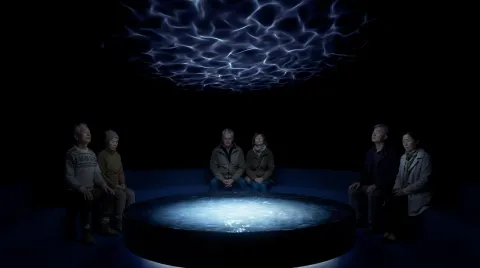
Soundscape
An immersive, multisensory space draws visitors into the rich and melodic world of whale sounds. The frequencies of some calls are so low that they resonate deep in the body, others so high as to be barely perceptible. In this dark embrace, soundwaves from the ocean deep, the weather, and the whales mix with lightwaves to form a delicate experiential dance.
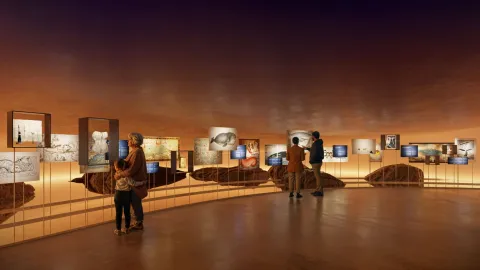
Library of Relations
Here, a contemplative atmosphere reflects our long and complicated relationship with whales. Visitors witness the uncomfortable impact of historical industrial whaling and the long road to recovery. Art, legend, literature, testimony, and film bring voice to the changing role of whales in our lives: at different times and different places, monsters, deities, necessities, commodities, muse, and ecological sentinels.
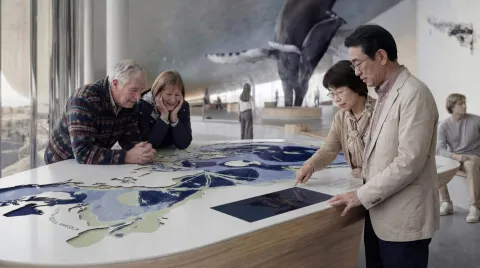
Horizons
From our perspective, there may be seven seas but from a whale’s perspective there is just one. Here, an alternative projection of the globe that reveals all the world’s oceans as a single body of water. Visitors see how whale habitats and migration routes overlap and crisscross with global ship traffic and other anthropogenic activities. This ocean-centric map provokes a mindshift in how visitors see the world. Everything is connected.
CafE AND Restaurant
The café and restaurant extend the visit beyond the exhibitions, offering a place to pause, reflect, and take in the surroundings. Inspired by the ocean and the northern landscape, the menu highlights seasonal ingredients and local flavors. Large windows frame the horizon, allowing guests to remain connected to the sea while enjoying a warm, welcoming atmosphere.

Outdoor area
Ravnholmen is a small rocky island located just outside The Whale and forms part of the natural coastal setting surrounding the building. A breakwater connects the mainland to the island, allowing visitors to walk safely out to the edge of the sea and experience the open coastline up close. Shaped by wind, tides, and shifting light, Ravnholmen offers uninterrupted views across the Norwegian Sea. The outdoor areas are accessible throughout the year. Visitors can explore the shoreline, walk along the breakwater, and use the surrounding terrain as part of their visit. The roof of The Whale is also publicly accessible and designed as a walkable landscape. From here, guests can enjoy panoramic views of the ocean, mountains, and horizon — in summer under the midnight sun and in winter beneath the northern lights. Nearby stands Andenes Lighthouse, a historic coastal landmark that has guided ships along the northern coast since 1859.
