Join Dorte Mandrup behind the architecture
In 2019, Dorte Mandrup won the international competition to design The Whale in Andenes. Step inside her studio and discover the vision behind an architecture shaped by landscape, light, and the powerful presence of the sea.
We really wanted to win this competition. It’s absolutely fantastic!
These were the words of Danish architect Dorte Mandrup during her first interview at Fyrvika in Andenes on 1 November 2019. Her jubilation is easy to understand. Her Danish architectural firm had just triumphed over competitors like Snøhetta, BIG and Reiulf Ramstad. Both the professional jury and the local community embraced Dorte’s proposal. In a poll conducted by Vesterålen Online, her design received more than half of the nearly 2,000 votes cast.

Create something spectacular that blends into the landscape
She had been given a demanding challenge, to put it mildly: “Create something spectacular that blends into the landscape”. Astonishingly enough, she had accomplished the seemingly impossible.
In November 2022, three years after visiting Andenes and being hailed as the winner, Dorte was back in Andøy. This time, more than 200 local residents marched in a torchlight procession to demand financial support for the project from the government. An enthusiastic Dorte Mandrup had a clear message for the national politicians: “You have the opportunity to create a destination of exceptional quality. Such opportunities don’t come along very often, so seize it.”
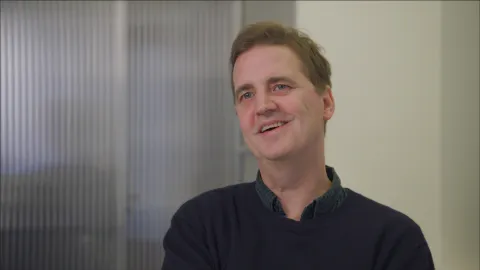
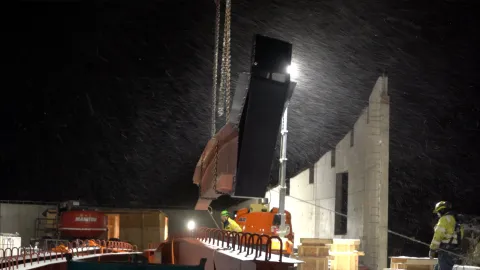
A further three years have passed. As we meet Dorte Mandrup in her architecture studio in Denmark, the construction work is about to start in Andenes.

Emotional
“A large part of the atmosphere and mood surrounding the building and the site is that this a place where we encounter nature. You are on the edge of the North Atlantic. Everyone perceives encountering nature like as a very emotional experience. The scale and distance are so great that you feel the presence of the ocean very clearly,” says Dorte.

In harmony with the surroundings
“When we visited the site, we – or – I had a strong sense that this building should blend in as much as possible with the truly spectacular surroundings. The building needed to be a harmonious composition within the landscape. A lighthouse that serves as a sort of landmark in the area is situated right beside the site and we did not want to compete with that.”
Gentle curve
“Our starting point became to work with a building that did something entirely different. In other words, what if this was about the horizon, rather than the connection between earth and sky? Given the adjacent lighthouse, it felt natural to create something horizontal, which gradually evolved into this gentle curve,” says Dorte.

The seabed on land
“The concept is a kind of continuation of the landscape from the seabed, rising upward. If you were to translate it into a metaphor, it’s as if a giant has just cut into and loosened the earth’s surface with a small knife, lifting it up and then placing this whale centre beneath it.”
Like looking down through water
“Many aspects of the Arctic, or of the climate, are also about what you perceive and experience through your senses. Naturally, this is something that we try to emphasise and frame as much as we can. The facade consists of curved glass. In a way, this dissolves the boundaries between outside and inside, creating a slightly blurred, ocean-like feeling. It’s almost as if you are looking down through water,” explains Dorte.

The building is intended to be inviting, friendly and welcoming. One of the key issues at the site was that the local community used this peninsula for recreation, including dog walking, and they could get right down to the water’s edge
Giving back
“The building is intended to be inviting, friendly and welcoming. One of the key issues at the site was that the local community used this peninsula for recreation, including dog walking, and they could get right down to the water’s edge. Suddenly, this building would take up that entire area. So we asked ourselves, how can we give something back to the local community by creating a place that everyone can access instead of taking something away from them?” says the architect.
“That is actually one of the reasons the building looks the way it does. It also looks the way it does because it’s a composition in the landscape that we want to insert ourselves into. This involves understanding the visual and aesthetic qualities of the site, as well as the cultural and social dimensions.”
What does the site need?
“It should ideally be a synthesis between our understanding of the site, what it has and what it needs. Afterall, we want to leave it in a way that makes people feel like they have received something and that nothing has been taken from them, says Dorte Mandrup.
Behind the scenes towards opening