Humpback Whale: Size, Behaviour, Migration and Arctic Sightings
Few marine animals capture the human imagination like the humpback whale. With their haunting songs, acrobatic leaps and epic migrations across the world’s oceans, humpbacks are among the most beloved and recognizable of all whale species. For visitors to Northern Norway, they offer one of the most awe-inspiring wildlife encounters in the Arctic – always delivering a breathtaking display of grace and power set against snow-covered fjords and winter light.

What is a Humpback Whale?
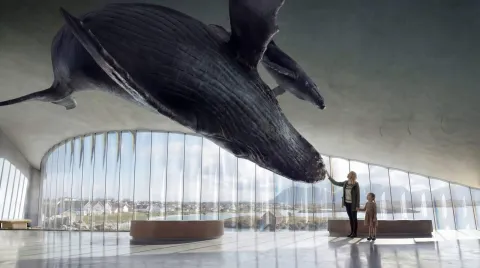
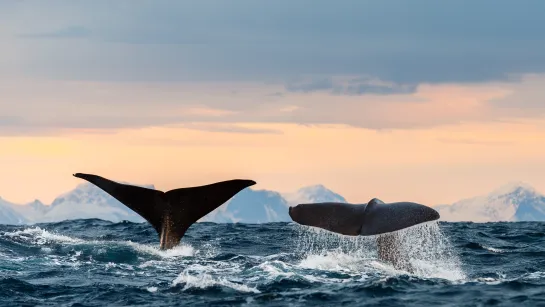
The humpback whale (Megaptera novaeangliae) is a species of baleen whale and part of the same family as the blue, fin and minke whales. The name “humpback” comes from the distinctive arch of their back just before they dive, often followed by a majestic lift of their massive tail flukes.
Humpbacks are known for three things above all else: their complex songs, their spectacular breaching behaviour and their long migrations that span entire ocean basins. Unlike toothed whales, humpbacks have baleen plates instead of teeth. These flexible keratin structures act like sieves, filtering small prey such as krill and schooling fish from seawater.
Each humpback has a unique pattern of white and black markings on the underside of its tail flukes. These serve as a kind of “fingerprint,” allowing scientists to identify individuals across decades of research.


How Big is a Humpback Whale?
Humpback whales are among the giants of the ocean, though not the largest. Adult humpbacks typically measure between 12 and 16 meters long (39–52 feet) and can weigh up to 36 metric tons. Females tend to be slightly larger than males.
Their enormously long pectoral fins sometimes reach five meters and give the species its scientific name: Megaptera, meaning “big wing.” These fins help them manoeuvre with surprising agility for an animal of such size.
A newborn calf already measures four to five meters and weighs around 900 kilograms. Fed on its mother’s rich milk, a calf can gain up to 45 kilograms a day during its first months of life.

Where do Humpback Whales Live?
Humpback whales travel far, inhabiting every major ocean on Earth. They follow an annual migration between high-latitude feeding grounds and low-latitude breeding areas.
During summer, they feed in cold, nutrient-rich polar and subpolar waters — including the Norwegian Sea, North Atlantic, North Pacific and parts of the Southern Ocean. As winter approaches, they embark on one of the longest migrations in the animal kingdom, traveling up to 8,000–9,000 kilometres to tropical or subtropical waters to breed and give birth.
In the North Atlantic, feeding grounds include the waters off Northern Norway, Iceland and Greenland. From late October through January, humpbacks gather in Norwegian fjords such as Tromsø, Skjervøy, and Andenes to feast on vast shoals of herring and capelin.
Why do Humpback Whales Sing?
Scientists continue to study the complex purpose of the humpback’s song, but it is widely believed to play a role in mating behaviour. Only males are known to sing, producing structured, evolving sequences of sounds that can last for 10–30 minutes and be repeated for hours.
Each population shares a distinctive “version” of the song that changes gradually over time — a phenomenon like regional dialects. Acoustic studies suggest that humpback songs are a form of social and reproductive display used to attract mates or establish dominance.
The intricacy of the songs is remarkable. They are composed of repeating themes, phrases and motifs that form patterns more akin to music than simple communication. These powerful sounds can travel more than 30 kilometres underwater, echoing through ocean depths far beyond the singer’s line of sight.
Can You see Humpback Whales in Norway?
Yes. Northern Norway is one of the best places in the world to see humpback whales. From late October to January, humpbacks follow herring shoals into fjords along Tromsø, Andenes and Skjervøy. During this season, the water comes alive with activity. They sometimes feed cooperatively with other humpbacks. A well-known method is bubble-net feeding, where they work together to herd fishlike herring into tight “bait balls.”
From a boat or even from shore, it’s common to see the distinctive blow, the arching back, and the broad tail raised high before a dive. In the low light of the Arctic winter, some lucky observers witness humpbacks breaching against a sky lit by the Northern Lights - a spectacle few forget.
Whale-watching tours in this region are guided by experts who follow strict codes of conduct to avoid disturbing the animals, ensuring an experience that’s both ethical and unforgettable.

Conservation and Threats
Once hunted nearly to extinction in the commercial whaling era, humpback whales have made a significant comeback since the global ban on hunting under the International Whaling Commission (IWC) in 1966. Today, their worldwide population is estimated at approximately 80,000 individuals, according to the IWC; a good sign of recovery, though still below historic levels.
Despite this progress, humpbacks face ongoing threats:
- Entanglement in fishing gear, which can cause injury or drowning.
- Ship strikes, particularly in busy coastal shipping lanes.
- Noise pollution from shipping, seismic surveys and tourism vessels, which interferes with their ability to communicate and navigate.
- Climate change, which disrupts prey distributions and migration timing.
In Norway, continued research and responsible ecotourism supported by institutions such as the Norwegian Polar Institute and the Institute of Marine Research help monitor whale populations and advocate for ocean stewardship.

Experience Whales in Northern Norway
Whale watching in Northern Norway provides a close look at humpbacks in their natural Arctic habitat. The best time to visit is between late autumn and early winter, when herring shoals draw them close to shore.
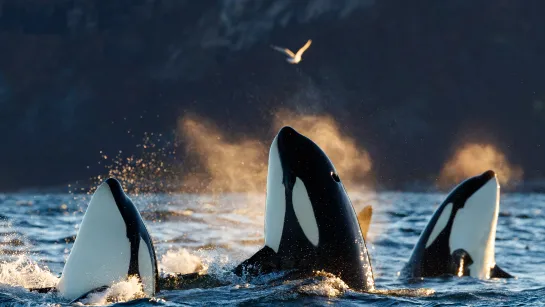
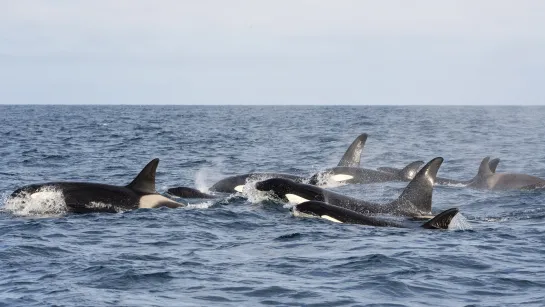
Excursions from Tromsø, Andenes and Skjervøy offer opportunities to encounter humpbacks, orcas and sometimes fin whales. Visitors can expect calm fjord waters, crisp Arctic air and a setting that combines rugged nature with quiet awe.
To experience whales responsibly:
- Choose licensed, sustainability-focused tour operators.
- Respect wildlife-viewing distances and guidance from crew.
- Bring warm clothing, patience, and curiosity — nature follows its own schedule.
Whether you spot a whale breaching or drifting silently through icy waters, it’s an unforgettable experience that underlines how fragile and magnificent life in the Arctic can be.


FAQs About Humpback Whales
- How long do humpback whales live?
-
They typically live 50 to 80 years, though some individuals may exceed that. Scientists determine age by counting growth layers in earwax plugs, much like tree rings.
- What do humpback whales eat?
-
They feed mainly on krill and small schooling fish such as herring, capelin, and sardines, consuming 1-2 tons per day during the feeding season.
- Do humpbacks live alone or in groups?
-
Humpbacks are largely solitary but often form temporary feeding groups.
- When is the best time to see humpback whales in Norway?
-
The best season stretches from late October to January, following the arrival of herring in the northern fjords.
- Are humpback whales dangerous to humans?
-
No. Humpbacks are gentle giants. Whale-watching guidelines ensure encounters remain safe and non-intrusive for both whales and people.
The Last Word
Humpback whales bridge worlds between the tropics and the Arctic, between myth and science. Their voices resonate through the ocean depths, echoes of endurance and renewal. For travellers to Northern Norway, meeting these giants is more than an adventure; it’s a reminder of the resilience of nature and the wonder that still moves freely in the world’s wild seas.