The Whale: Architecture Defined by Land and Sea
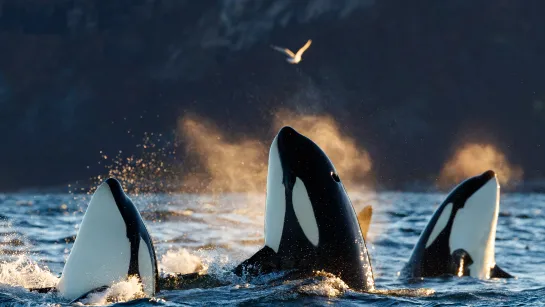
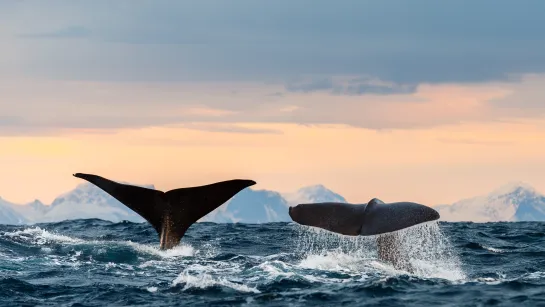
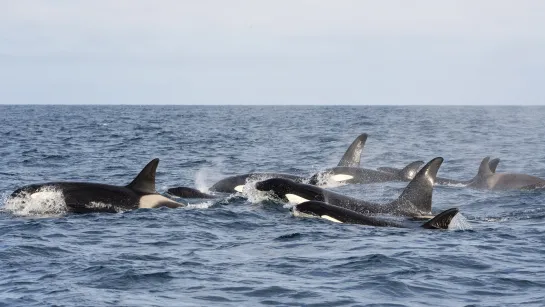
Rugged mountain tops, lowland marshes and peats characterize Andøya, but compared to many other places this far North, the gulf stream makes for a welcoming climate for numerous migrating whales. This pit-stop has made Andenes one of the best places in the world to spot whales and is the reason The Whale will be built there; on the edge of this magnificent underwater-world.
The landscape surrounding The Whale is essential for the shape of the building.
Shaped by the Surroundings
The landscape surrounding The Whale is essential for the shape of the building. The form of the roof is defined by three high points on the site, and the foundation is influenced by the landscape beneath it. The surface of the roof is covered with natural, unworked stones from the area, and large windows opening towards the archipelago underline the connection between landscape and building.

The curved roof becomes a new viewpoint that visitors and locals are invited to walk on. From here you can overlook the archipelago, marvel at the midnight sun’s reflection in the ocean or the northern lights dancing over the sky. A single curved concrete shell makes up the roof of The Whale. By using this parabolic form, the structure effectively transmits the forces to three support points in the corners of the building.

As a result of this curvature, one can achieve relatively long spans while minimizing material use, resulting in an economical and sustainable design. At the same time, the shape of the building provides a minimal surface area, compared to floor area and volume, which is favourable for both material and energy consumption. The shape is aerodynamic, meaning that no negative turbulence effects will occur, and snow build-up will be minimized.

Entering The Whale
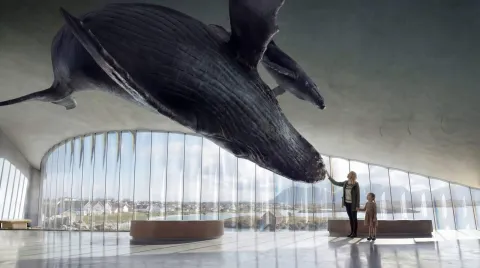
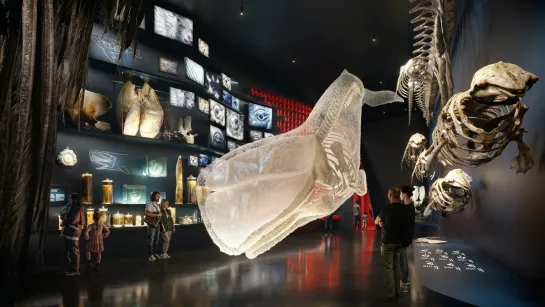
Inside The Whale a large space opens naturally towards the mountains and the sea. A long horizontal view of the mountains and archipelago creates a direct visual connection between the surroundings and the exhibition, which is underlined by the rocks entering the building in multiple places.

The building will house exhibition spaces, offices, a café and a store, and around the attraction a carefully planned web of paths, platforms and viewpoints highlight the landscape. A new walkway across the breakwater leads to Ravholmen, transforming the island into a public recreation area that seamlessly connects the building with the coastal landscape.

Architecture
Dorte Mandrup A/S
Partners
Marianne Levinsen Landscape, Landscape
Ralph Appelbaum Associates & Tamschick Media + Space, Exhibition Design
Norconsult A/S, Engineer
Consultants
Nils Øien, Senior Reseacher, Norwegian Institute of Marine Research
Anders Kold, Artistic Consultant, Louisiana Museum of Modern Art
AT Plan & Arkitektur, Local Planning Consultant
Thornton Tomasetti, Concept engineer