Sperm Whale: the Deep-Diving Giant of the Ocean
No animal better illustrates the extremes of life in the ocean than the sperm whale. The largest of all toothed whales and one of the most accomplished divers in the animal kingdom, this species dominates the deep seas. In the Norwegian Arctic, particularly around Andøya, sperm whales are not rare visitors but permanent residents of the waters.
What is a Sperm Whale?
The sperm whale (Physeter macrocephalus) is the sole living member of its genus and one of three in the family Physeteridae. Its enormous, box-shaped head can make up nearly one third of the body’s length and houses the spermaceti organ, a cavity filled with waxy oil that helps regulate buoyancy and amplify sound during echolocation. Males typically reach 16–20 metres and up to 57 metric tonnes, whereas females average 11–13 metres and about 15 tonnes. The pronounced sexual dimorphism reflects different ecological roles: females and calves remain in warm tropical or subtropical waters year-round, while males migrate towards colder feeding grounds at high latitudes, including northern Norway.
How Deep can a Sperm Whale Dive?
Sperm whales hold the record for the deepest dives among mammals. Documented dives exceed 2,000 metres, lasting as long as 90 minutes before resurfacing to breathe. Typical foraging dives range from 400 to 1,500 m.
Their bodies are built for pressure and darkness:
- Blood rich in myoglobin stores large oxygen reserves.
- A flexible ribcage allows the lungs to collapse safely at depth.
- Circulation shifts oxygen flow towards vital organs during long dives.
At the surface, the whale exhales with a powerful, forward-angled blow up to six metres high and its diagonal spout is a key identification feature off Andøya’s coast.
Why are Sperm Whales Found Near Andøya?
The Bleik Canyon, located just west of Andøya in the Vesterålen archipelago, plunges more than 1,000 metres deep only a few kilometres offshore. Upwellings along the canyon rim concentrate nutrients, attracting squid and deep-water fish – the sperm whale’s primary prey.
This unique undersea topography creates a perfect year-round habitat. Mature males frequent these cold feeding grounds consistently, and research from Norwegian marine institutes shows individuals return to the same zones season after season, demonstrating strong site fidelity.
Unlike humpbacks or orcas, sperm whales do not enter coastal fjords but remain offshore. Still, Andøya’s deep waters lie so close to land that boats can reach prime whale territory within minutes, making it one of the most accessible sperm whale areas in the Northern Hemisphere.

Social Structure and Behaviour
Sperm whales exhibit highly organised societies.
- Females and calves form long-term matrilineal groups of 10–20 individuals, maintaining lifelong bonds.
- Adult males live alone or in temporary bachelor groups, migrating over decades from low-latitude nurseries to polar feeding zones.
They communicate through sequences of broadband clicks known as codas, which are recognisable patterns unique to each social group. Norwegians conducting acoustic studies near Andøya report distinct “dialects”, possibly used for group identification and social cohesion.
Clicks used for echolocation are among the loudest sounds produced by any animal, reaching about 230 decibels underwater. These acoustic bursts enable whales to locate prey hundreds of metres away in total darkness.
What do Sperm Whales Eat?
Sperm whales consume mostly squid, supplemented by octopods and deep-sea fish such as codlings and Greenland halibut. Analyses of individuals stranded in Norway show diets dominated by Gonatus squid, abundant at bathyal depths. An adult male may eat roughly one tonne of prey per day. Scars often visible on the whales’ heads and flanks are consistent with encounters with large squid species, including the giant squid (Architeuthis dux).

Can You see Sperm Whales in Norway?
Yes. The premier location is Andøya. Because of the island’s proximity to the deep Bleik Canyon, sperm whales are visible throughout the year, a rarity in Europe.
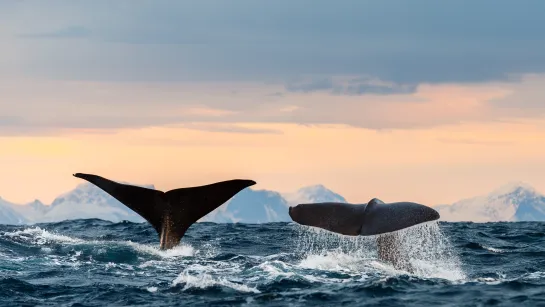
Whale-watching departures from Andenes take visitors directly to these offshore canyons, where sperm whales surface between dives about every hour. Observers see the slanted spout, the slow arch of the back and finally the broad, triangular tail flukes lifting clear before the descent.
While summer provides calmer seas and extended daylight, winter tours offer the added extra of the Northern Lights. Strict national whale-watching regulations ensure encounters remain safe and non-intrusive for the whales.

Conservation and Research
Commercial hunting nearly wiped out the sperm whales before international protection under the IWC moratorium in 1986. Populations have since stabilised, and the species is listed as “least concern” on the IUCN Red List, though localised data remain limited.
Key modern threats include:
- Fishing gear entanglement in deep-set longlines.
- Ship collisions in heavily trafficked areas.
- Noise, notably from seismic surveys and shipping, which interferes with echolocation.
- Plastic and chemical pollution reaching deep habitats.
- Climate change, which may alter prey availability at depth.
At Whalesafari in Andenes, acoustic hydrophones and photo-identification programmes contribute to international research. Scientists from the Norwegian Polar Institute and the Institute of Marine Research analyse sperm whale vocalisations, track migration routes, and study behavioural ecology within the Bleik Canyon.
These efforts not only advance marine science but also link sustainable tourism with conservation, showing that economic and environmental goals can coexist in Arctic Norway.

FAQs About Sperm Whales
- How big can sperm whales get?
-
Adult males reach about 20 metres in length and can weigh up to 57 tonnes. Females average 11–13 m.
- How long can they hold their breath?
-
Up to 90 minutes on deep dives, though most last 45–60 minutes.
- Why do sperm whales click?
-
Clicks serve two main purposes: echolocation for detecting prey and communication among individuals using patterned codas.
- Where can I see sperm whales in Norway?
-
At Andøya in Vesterålen, where the Bleik Canyon’s deep waters allow sightings all year.
- Are sperm whales dangerous to humans?
-
No. Despite their size, they are docile towards boats when approached responsibly.


The Last Word
Built for extremes, sperm whales push the limits of mammalian life – from crushing ocean pressure to planetary-scale migrations. Off Andøya, their presence turns the Arctic Ocean into a living laboratory of science and wonder. Observing these giants surfacing from 1,000-metre depths is one of Norway’s defining natural experiences and a direct connection to the wild.